
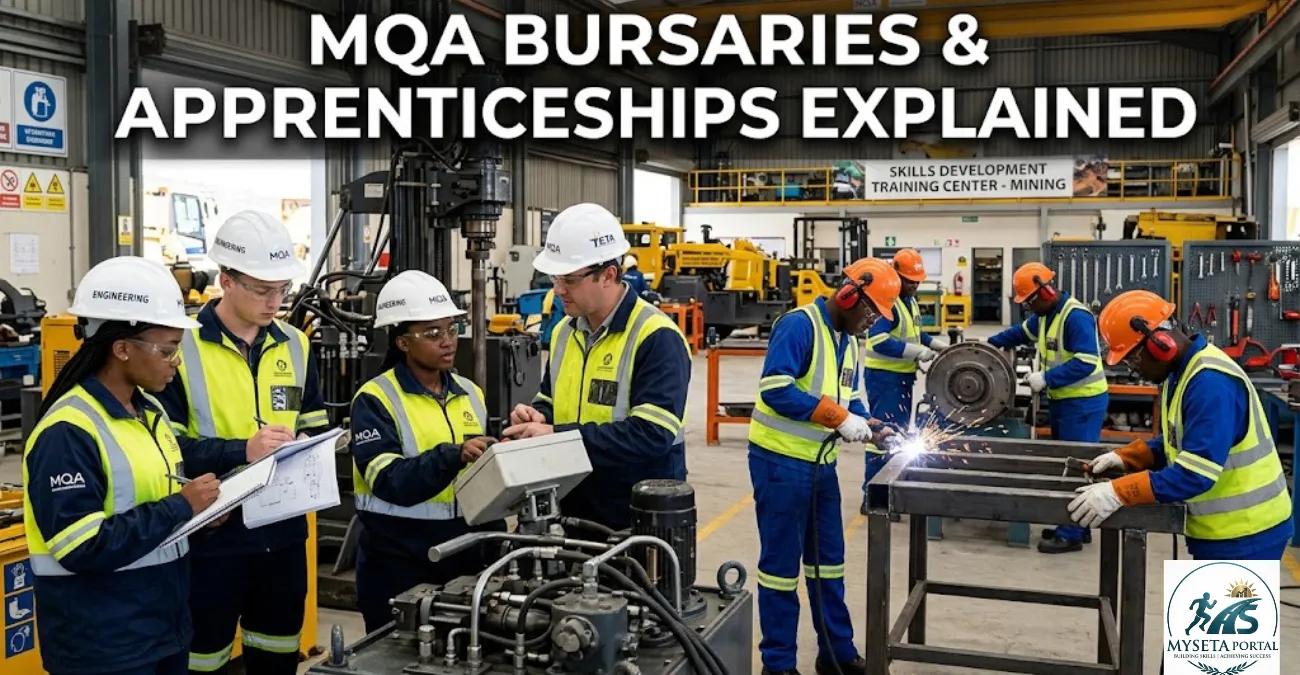
MQA Bursaries and Apprenticeships Explained
The Mining Qualifications Authority (MQA) plays a major role in developing skills for South Africa’s mining and minerals sector. Through bursaries, apprenticeships, learnerships, internships and skills programmes, the MQA helps young people gain qualifications and practical experience needed for careers in mining.
For students and job seekers interested in engineering, mining operations, geology, surveying, and artisan trades, MQA funding opportunities can provide an important pathway into the industry.
What Is the MQA?
The Mining Qualifications Authority is the Sector Education and Training Authority (SETA) responsible for skills development within the mining and minerals sector.
Its responsibilities include:
- Funding bursaries
- Supporting apprenticeships
- Promoting artisan development
- Funding learnerships and internships
- Developing scarce and critical skills
- Supporting transformation within the mining sector
The MQA works with mining companies, training providers and educational institutions to build a skilled workforce for the industry.
What Are MQA Bursaries?
MQA bursaries provide financial assistance to qualifying students pursuing studies in mining-related fields.
The purpose of these bursaries is to address skills shortages and develop future professionals for the mining industry.
Fields Commonly Supported by MQA Bursaries
Students may receive funding for qualifications in:
- Mining Engineering
- Metallurgical Engineering
- Electrical Engineering
- Mechanical Engineering
- Industrial Engineering
- Geology
- Mine Surveying
- Rock Engineering
- Environmental Management
- Occupational Health and Safety
Funding opportunities may vary from year to year depending on industry needs.
What Does an MQA Bursary Cover?
Depending on the bursary programme, funding may assist with:
- Tuition fees
- Accommodation
- Prescribed textbooks
- Study materials
- Living allowances
- Other approved academic expenses
Students should always review the official bursary advertisement for specific funding details.
Who Can Apply for an MQA Bursary?
Requirements may vary, but applicants generally need:
- South African citizenship
- Strong academic performance
- Acceptance or registration at a recognised institution
- A qualification in an approved field of study
- Compliance with the bursary requirements for that year
Priority is often given to fields experiencing skills shortages within the mining sector.
What Are MQA Apprenticeships?
MQA apprenticeships combine practical workplace training with formal technical education.
These programmes are designed to help learners become qualified artisans in trades that are critical to mining operations.
Apprentices receive structured training while gaining hands-on experience in real working environments.
Trades Commonly Supported Through MQA Apprenticeships
Examples include:
- Electrician
- Fitter and Turner
- Boilermaker
- Diesel Mechanic
- Millwright
- Instrument Mechanic
- Rigger
- Auto Electrician
- Welder
These trades are essential for maintaining and operating mining equipment and infrastructure.
How Do MQA Apprenticeships Work?
An apprenticeship typically includes:
Theoretical Training
Learners attend training at accredited institutions where they develop technical knowledge.
Workplace Training
Apprentices gain practical experience under the supervision of qualified artisans.
Trade Test Preparation
After completing the required training and workplace experience, apprentices may qualify to attempt a trade test.
Successful completion can lead to artisan status.
Benefits of MQA Apprenticeships
Participants may gain:
- Practical workplace experience
- Industry-recognised qualifications
- Exposure to mining operations
- Technical skills development
- Improved employment prospects
- Opportunities for long-term career growth
Because qualified artisans remain in demand across many industries, apprenticeship training can provide strong career opportunities.
Difference Between an MQA Bursary and an Apprenticeship
| MQA Bursary | MQA Apprenticeship |
|---|---|
| Supports academic studies | Supports artisan training |
| Focuses on tertiary education | Focuses on workplace learning |
| Usually for university or TVET students | Usually for trade occupations |
| Leads to professional careers | Leads to artisan careers |
| Covers study costs | Provides practical training |
Both pathways contribute to skills development but serve different career goals.
Career Opportunities After MQA Programmes
After a Bursary
Graduates may pursue careers such as:
- Mining Engineer
- Geologist
- Mine Surveyor
- Metallurgical Engineer
- Environmental Specialist
- Safety Officer
After an Apprenticeship
Qualified artisans may work as:
- Electrician
- Boilermaker
- Millwright
- Diesel Mechanic
- Fitter
- Instrument Technician
Many of these occupations are classified as scarce skills in South Africa.
Required Documents Often Requested
Applicants may be asked to submit:
- South African ID
- Academic records
- Matric certificate
- Proof of registration or acceptance
- Curriculum Vitae (CV)
- Proof of residence
- Relevant supporting documents
Always check the requirements for the specific programme before applying.
Frequently Asked Questions (FAQ)
Is MQA only for mining careers?
MQA focuses on mining and minerals-related occupations, but many supported skills are transferable to other industries.
Can TVET students apply for MQA opportunities?
Yes. Many bursary, apprenticeship and skills development opportunities are available to TVET College students.
Are MQA apprentices paid?
Many apprenticeship programmes provide a training allowance or stipend, depending on the employer and programme structure.
Do MQA bursaries need to be repaid?
Most bursaries do not require repayment if all bursary conditions are met, but applicants should review the specific bursary agreement.
Where can I find MQA opportunities?
Opportunities are usually advertised through the official MQA channels, training providers, mining companies and educational institutions.
Expert Guidance (E-E-A-T – Martine Smith)
Martine Smith, Skills Development and Career Guidance Advisor, encourages young people to understand the difference between academic and artisan career pathways before applying.
“A bursary is ideal for students pursuing university or college studies, while an apprenticeship is designed for individuals who want to become qualified artisans through practical training. Both routes offer valuable opportunities and can lead to rewarding careers.”
Martine recommends:
- Researching career paths before applying
- Monitoring MQA announcements regularly
- Maintaining strong academic results
- Preparing application documents early
- Considering both technical and professional career options
Grow Your Career with MySETA Portal
Unlock real opportunities that help you move from learning to earning. MySETA Portal connects South African youth with trusted and up-to-date career development opportunities designed to build skills and open doors.
Whether you are a matriculant, unemployed graduate, or someone looking to upskill, this platform helps you stay ahead with opportunities that matter.
What you can access:
- Career Guides
- SETA Guides
- SETAs
- Bursaries
- Learnerships
- Internships
- Training Programmes
- TVET Opportunities
- Government Vacancies
- Courses
- Apprenticeships
Professional Disclaimer
Advice & Insights by Martine Smith, Founder and Managing Editor of MySETA Portal

MySETA Portal is an independent information platform and is not affiliated with any SETA, government department, or public institution.
While we strive to publish accurate and up-to-date information, readers should always verify opportunities, requirements, and deadlines through official SETA, DHET, employer, or government websites before applying.
The content published on MySETA Portal is provided for informational purposes only and should not be considered legal, financial, educational, or professional career advice. Readers are encouraged to seek qualified professional guidance where appropriate.

Martine Smith is the Founder and Managing Editor of MySETA Portal, he writes about SETA learnerships, internships, bursaries and youth employment opportunities in South Africa. His goal is to help young people access trusted career information and skills development programmes. Email: info@mysetaportal.co.za