
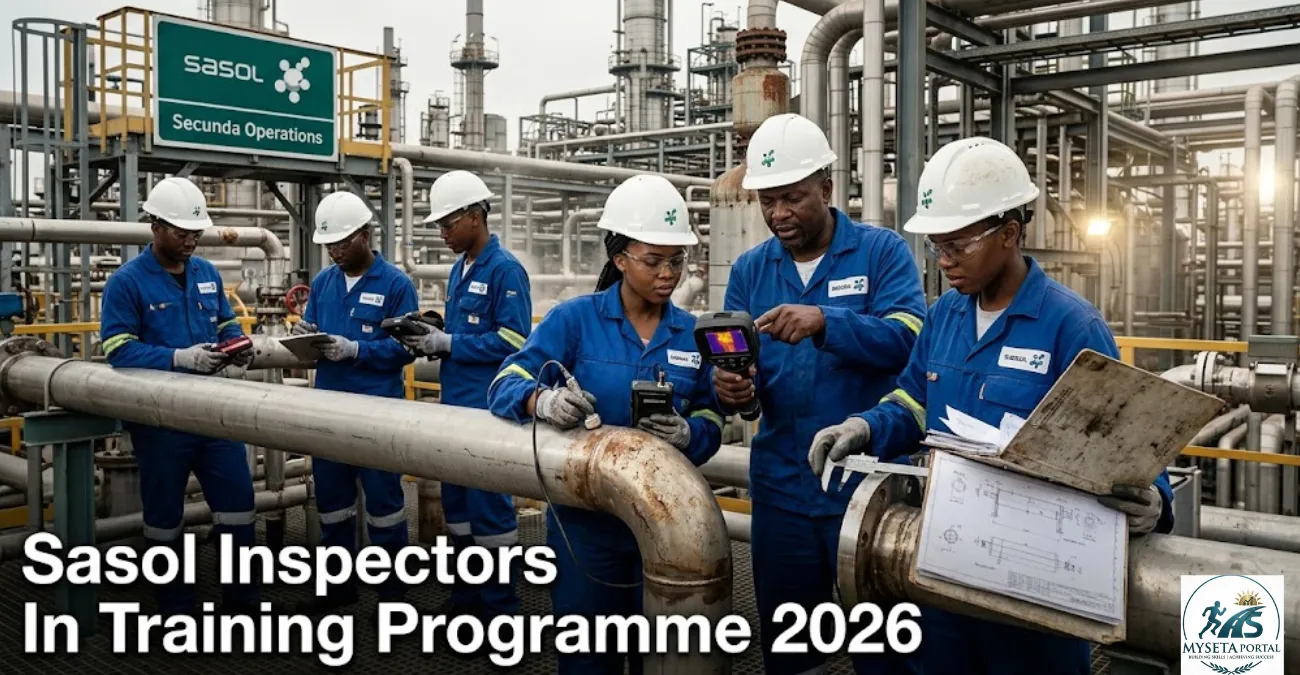
If you enjoy technical problem-solving, engineering systems, quality control or industrial safety, the Sasol Inspectors In Training (NPE) Programme could become one of the most valuable career opportunities available this year.
Applications are now open for aspiring technical professionals to join a fully accredited three-year training programme at Sasol’s operations in Secunda, Mpumalanga.
Designed to develop future Inspectors of Pressurised Equipment (IPEs) and Competent Person (CP) Inspectors, the programme offers structured technical training, workplace exposure and specialised engineering inspection skills.
Sasol Inspectors In Training (NPE) Programme 2026
Sasol is recruiting future technical professionals through its Inspectors In Training (NPE) Programme.
Successful candidates will receive accredited training focused on industrial inspection, engineering safety, technical compliance and equipment integrity.
Quick Overview
- Opportunity: Sasol Inspectors In Training (NPE) Programme 2026
- Reference Number: 12077
- Location: Secunda
- Closing Date: 12 June 2026
- Programme Duration: 3 Years
- Training Accreditation: Southern African Institute of Welding
- Minimum Qualification: Grade 12 (Matric)
- Preferred Qualification: S4 Mechanical Engineering, Metallurgy or Welding Engineering
- Industry: Engineering Inspection and Industrial Safety
- Employment Type: Training Programme
No stipend amount was stated in the advert. However, structured industrial training programmes often include learner support or employee-related benefits depending on programme conditions.
Why This Programme Matters for South African Youth
Many learners know about careers in engineering, but far fewer understand the importance of industrial inspection.
Every pressure vessel, steam generator, storage tank and industrial pipeline must be inspected regularly to ensure safety, legal compliance and operational reliability.
This means inspection professionals play a direct role in protecting:
- Human lives
- Industrial infrastructure
- Environmental safety
- Equipment reliability
- Regulatory compliance
For young South Africans with strong Mathematics and Physical Science backgrounds, this programme creates a pathway into a highly specialised profession with strong long-term demand.
Future Employability: What Career Opportunities Can This Open?
The biggest advantage of this programme is specialisation.
Industrial inspection skills are highly transferable across multiple sectors.
Graduates may pursue careers in:
- Industrial Inspection
- Engineering Integrity Management
- Pressure Equipment Inspection
- Welding Inspection
- Quality Assurance
- Engineering Compliance
- Mechanical Inspection
- Industrial Risk Assessment
- Safety and Reliability Engineering
These opportunities exist across industries such as:
- Petrochemicals
- Mining
- Manufacturing
- Oil and Gas
- Renewable Energy
- Power Generation
- Engineering Consulting
Because industrial safety and equipment integrity remain critical, experienced inspectors are often highly valued technical specialists.
What Does an Inspector In Training Actually Do?
The programme combines technical learning with workplace exposure.
Learners gradually develop the ability to inspect, assess and certify industrial equipment while working alongside experienced inspection professionals.
Areas of Practical Training
Successful trainees may gain exposure to:
- Equipment integrity management
- Welding inspections
- Non-destructive testing (NDT)
- Pressure equipment regulations
- Risk-based inspections (RBI)
- Industrial safety compliance
- Technical reporting
- Engineering certification processes
This exposure helps build practical technical competence over time.
Understanding Non-Destructive Testing (NDT)
One of the most exciting aspects of this programme is exposure to advanced inspection technologies.
Unlike traditional testing methods, non-destructive testing (NDT) allows inspectors to evaluate equipment without damaging it.
Inspection Technologies You May Learn
- Ultrasonic Testing (UT)
- Time of Flight Diffraction (TOFD)
- Phased Array Ultrasonic Testing (PAUT)
- Infrared Inspection (IRIS)
- Eddy Current Testing
- Guided Ultrasonic Testing (GUL)
- Conventional X-rays
- Computed Radiography
These technologies are widely used across major industries around the world.
Experience with advanced inspection systems can significantly strengthen long-term employability.
RELATED: Sasol Administration Learnership Programme 2026: How Matriculants Can Gain Real Workplace Experience
Practical Inspection Skills You Will Learn
Visual Inspections
Visual inspection forms the foundation of industrial integrity management.
Trainees learn to identify:
- Corrosion
- Cracks
- Structural damage
- Wear and tear
- Equipment defects
Wall Thickness Measurements
Inspectors use specialised tools to determine whether pressure equipment has become thinner due to corrosion or erosion.
This helps prevent dangerous equipment failures.
Magnetic Particle Testing
Trainees learn to identify surface and near-surface defects in metallic materials.
Learning areas include:
- Testing procedures
- Result interpretation
- Compliance standards
Dye Penetrant Testing
This technique identifies defects that may not be visible to the naked eye.
Trainees gain practical exposure to inspection procedures and interpretation.
Pressure Equipment Inspections
Participants learn how to inspect:
- Pressure vessels
- Steam generators
- Piping systems
These inspections are completed according to pressure equipment regulations and industrial safety standards.
Technical Reporting and Documentation
Technical knowledge alone is not enough.
Inspectors must communicate findings accurately and professionally.
During training, learners may gain experience in:
- Writing technical reports
- Recording inspection findings
- Reviewing compliance records
- Assessing manufacturing documentation
- Supporting engineering decisions
Strong reporting skills are essential because inspection findings influence maintenance planning and operational decisions.
Minimum Requirements
Applicants must meet the following educational requirements.
Grade 12 Requirements
Candidates must have:
- Minimum 50% in Pure Mathematics
- Minimum 50% in Physical Science
- Minimum 50% in English
Advantageous Qualifications
Applicants with the following may receive favourable consideration:
- S4 Mechanical Engineering
- S4 Metallurgical Engineering
- S4 Welding Engineering
Additional Advantage
A valid driver’s licence may strengthen an application but is not compulsory.
Skills That Will Help You Succeed
Sasol highlights several qualities important for success.
These include:
- Excellent communication skills
- Strong learning ability
- Attention to detail
- Technical curiosity
- Problem-solving skills
- Professional conduct
- Ethical decision-making
- Commitment to academic excellence
Inspection careers require professionals who can work objectively and maintain strict safety standards.
How to Improve Your Chances of Selection
Competition for technical programmes is often high.
To improve your chances:
- Apply early
- Ensure Matric results are clearly visible
- Highlight engineering or technical subjects
- Include projects or practical exposure
- Mention technical hobbies or interests
- Use a professional CV
- Proofread carefully before submission
Small details often separate shortlisted applicants from unsuccessful ones.
Important Closing Date
Applications close on:
12 June 2026
Late applications may not be considered.
Applying early gives applicants enough time to fix documentation issues and avoid technical submission problems.
How to Apply
APPLY FOR THE SASOL INSPECTORS IN TRAINING (NPE) PROGRAMME 2026 HERE
Martine Smith’s Expert Insight
Many learners ignore technical opportunities like this because they assume inspection careers are “too specialised.”
In reality, technical inspection is one of the strongest long-term engineering support careers.
Here are four ways applicants can stand out:
1. Show Technical Curiosity
Mention school engineering projects, practical hobbies, workshop exposure or problem-solving activities.
2. Prioritise Mathematics and Science Performance
Strong Mathematics and Physical Science results matter. If these are your strengths, make them visible on your CV.
3. Demonstrate Attention to Detail
Inspection work demands accuracy. Small application mistakes can unintentionally signal poor attention to detail.
4. Research the Profession Before Applying
Candidates who understand equipment inspection, compliance and industrial safety usually present stronger motivation in interviews.
Grow Your Career with MySetaPortal
Unlock real opportunities that help you move from learning to earning. MySETA Portal connects South African youth with trusted and up-to-date career development opportunities designed to build skills and open doors.
Whether you are a matriculant, unemployed graduate, or someone looking to upskill, this platform helps you stay ahead with opportunities that matter.
What you can access:
- Career Guides
- SETA Guides
- SETAs
- Bursaries
- Learnerships
- Internships
- TVET Opportunities
- Government Vacancies
- Courses
- Apprenticeships
- Graduate Programme
- Government Services
Final Thoughts
The Sasol Inspectors In Training (NPE) Programme offers more than technical exposure.
It provides a structured route into a highly specialised profession responsible for industrial safety, engineering reliability and equipment compliance.
For learners who enjoy technical systems, structured problem-solving and engineering environments, this opportunity could become the foundation of a respected long-term career.
Applicants should prepare their documents carefully and apply before 12 June 2026.
For more verified learnerships, engineering opportunities, bursaries and youth career programmes, visit Mysetaportal.co.za.
Disclaimer: Mysetaportal.co.za is an independent information publisher and is not affiliated with Sasol, SAIW or any South African government department. Applicants should always verify requirements and deadlines through official employer channels.

Martine Smith is the Founder and Managing Editor of MY SETA portal, he writes about SETA learnerships, internships, bursaries and youth employment opportunities in South Africa. His goal is to help young people access trusted career information and skills development programmes. Email: info@mysetaportal.co.za