
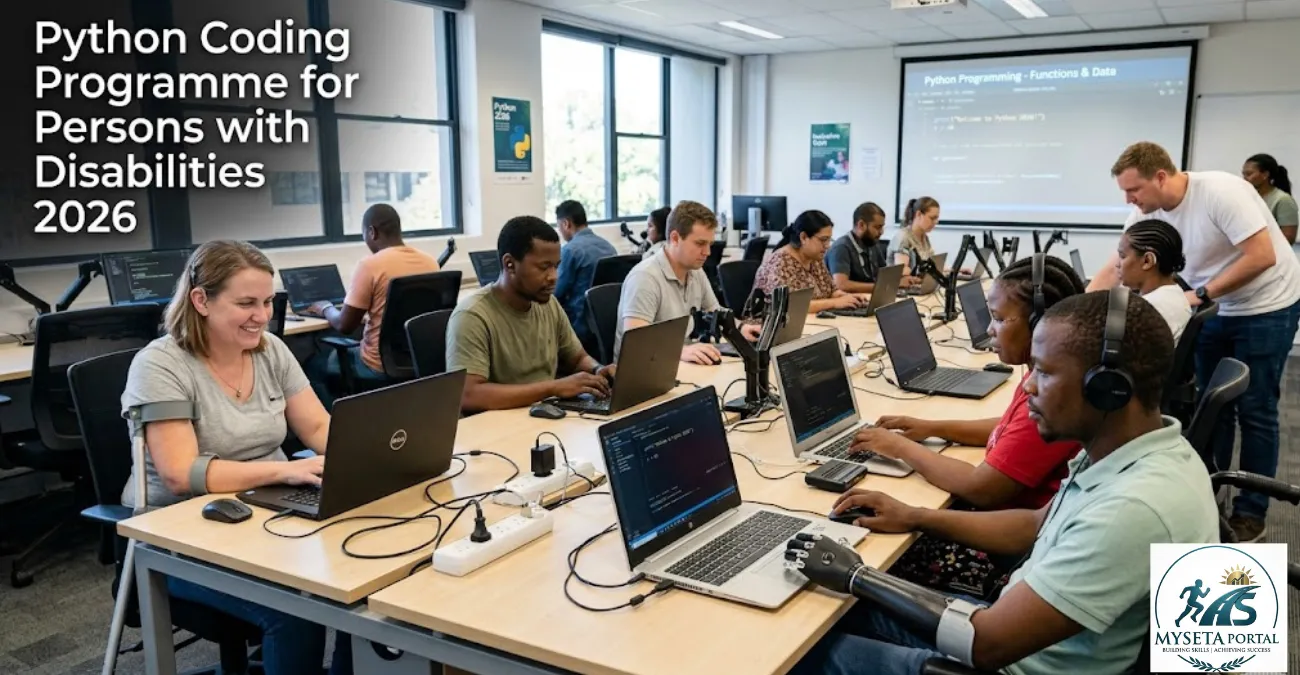
South Africa’s digital economy continues to expand, creating growing demand for people with technology skills. From software development and automation to data science and artificial intelligence, coding has become one of the most valuable skills in today’s job market.
To ensure that persons with disabilities are not left behind in the digital transformation of the economy, the Office of the Premier Free State Province, the Department of Women, Youth and Persons with Disabilities, and Human Capital Learning Solutions (HCLS) have launched a Python Coding Programme for Persons with Disabilities 2026.
This QCTO-accredited occupational skills programme aims to equip participants with practical coding knowledge, problem-solving abilities, and workplace-ready digital skills that can support future employment opportunities in the technology sector.
Quick Overview
| Programme Information | Details |
|---|---|
| Programme Name | Python Coding Programme for Persons with Disabilities 2026 |
| Programme Type | QCTO Accredited Occupational Skills Programme |
| Training Provider | Human Capital Learning Solutions (HCLS) |
| Location | Edenburg, Free State |
| Applications Open | 01 June 2026 |
| Closing Date | 12 June 2026 |
| Start Date | 22 June 2026 |
| Minimum Qualification | Grade 12 (Matric) or Equivalent |
| Age Requirement | 18 Years and Older |
| Target Group | Persons with Disabilities |
| Training Focus | Python Programming and Digital Skills |
| Accreditation | QCTO Accredited |
About the Programme
The Python Coding Programme is a specialised digital skills initiative designed to empower persons with disabilities through practical technology training.
Participants will gain exposure to:
- Python programming
- Digital literacy
- Coding fundamentals
- Problem-solving techniques
- Real-world projects
- Workplace-ready technical skills
Unlike many theoretical courses, the programme focuses on practical application, allowing learners to build projects and develop a portfolio that can strengthen future job applications.
Why Python Is One of the Most Valuable Skills in 2026
Python remains one of the most widely used programming languages globally because it is versatile, beginner-friendly, and used across multiple industries.
Python is commonly used in:
- Software Development
- Web Development
- Artificial Intelligence (AI)
- Machine Learning
- Data Science
- Automation
- Cybersecurity
- Cloud Computing
- Data Analytics
Many employers value Python skills because the language can be applied to a wide range of business and technology challenges.
About Human Capital Learning Solutions (HCLS)
Human Capital Learning Solutions (HCLS) is a skills development provider focused on improving employability and supporting economic participation through accredited occupational training programmes.
The organisation works with government departments and development partners to address skills shortages and create opportunities for historically disadvantaged communities.
This programme is supported by:
- Office of the Premier Free State Province
- Department of Women, Youth and Persons with Disabilities
- Quality Council for Trades and Occupations (QCTO)
The initiative demonstrates a commitment to creating inclusive opportunities within South Africa’s growing digital economy.
Who Should Apply?
Applicants must meet the following requirements:
Eligibility Criteria
- South African citizen
- 18 years or older
- Matric (Grade 12) or equivalent qualification
- Person with a disability
- Interest in technology and digital skills
- Willingness to learn programming
The programme appears suitable for beginners, as previous coding experience is not listed as a requirement.
What Participants Will Learn
The curriculum covers foundational and practical Python programming concepts.
Python Fundamentals
Participants will learn:
- Python syntax
- Variables
- Data types
- Operators
- Control structures
Data Structures
Learners will gain experience working with:
- Lists
- Tuples
- Sets
- Dictionaries
Functions and Modules
Training includes:
- Creating functions
- Reusable programming techniques
- Module implementation
- Project organisation
File Handling
Participants will learn how to:
- Read files
- Write files
- Store information
- Manage data effectively
Problem-Solving Skills
The programme also develops:
- Logical thinking
- Algorithmic reasoning
- Analytical skills
- Structured problem-solving
Real-World Projects
Learners will apply their knowledge by:
- Building practical coding projects
- Creating portfolio pieces
- Developing technology solutions
These projects can help demonstrate skills to future employers.
What the Programme Includes
Successful participants will receive access to several valuable benefits.
QCTO-Accredited Training
Participants receive recognised occupational skills training aligned with industry standards.
Accessible Learning Support
The organisers have indicated that accessible learning materials and assistive support will be available.
Mentorship Opportunities
Participants may benefit from:
- Trainer support
- Peer learning
- Learning communities
- Professional guidance
Career Development Support
The programme includes elements designed to improve job readiness and employability.
Certification
Participants who successfully complete the programme will receive certification.
Related Opportunity
You may also explore
- Vhembe TVET College 4IR Training Programmes 2026: 100 Opportunities Available for Future Tech Careers
- Mbhashe Municipality Offers 24 Public Safety Opportunities With a R5 500 Monthly Stipend for Youth
Career Opportunities After Completion
Coding skills can support a variety of entry-level career pathways.
Potential opportunities include:
Junior Python Developer
Assist with software development projects and coding tasks.
Data Analyst (Entry-Level)
Work with data to support decision-making and reporting.
Automation Assistant
Help businesses automate repetitive processes and workflows.
Software Tester
Support quality assurance and software testing activities.
IT Support Technician
Combine technical support responsibilities with automation and scripting skills.
Freelancer
Offer coding and digital services independently.
Technology Entrepreneur
Develop software products, applications, or digital business solutions.
Required Documents
Applicants should prepare the following:
- South African ID Document
- Updated Curriculum Vitae (CV)
- Matric Certificate
- Proof of Disability (where applicable)
- Additional Qualifications (if available)
- Updated Contact Details
Preparing these documents in advance can help streamline the application process.
How to Apply
Interested applicants can submit their applications through the official programme channels.
Website: www.hcls.co.za/apply
Contact Information
Telephone: 012 051 7014
Email: info@hcls.co.za
Applicants should ensure that all supporting documents are ready before submitting their applications.
Important Dates
| Event | Date |
| Applications Open | 01 June 2026 |
| Applications Close | 12 June 2026 |
| Programme Start Date | 22 June 2026 |
Late applications may not be considered.
Frequently Asked Questions (FAQs)
Do I need coding experience to apply?
No. Previous coding experience is not listed as a requirement, making the programme suitable for beginners.
Is the programme accredited?
Yes. The programme is accredited by the QCTO.
Who can apply?
South African citizens who are 18 years or older, have Matric or an equivalent qualification, and are persons with disabilities.
Where will training take place?
Training will be conducted in Edenburg, Free State.
When do applications close?
Applications close on 12 June 2026.
When does the programme start?
Training is scheduled to begin on 22 June 2026.
What programming language will be taught?
Participants will learn Python programming.
Will participants receive certification?
Yes. Successful participants will receive certification upon completion.
Martine Smith’s Expert Insight
Digital skills are becoming increasingly important across every sector of the economy. Programmes such as this provide an opportunity for persons with disabilities to gain practical skills that can support long-term career growth.
If you are interested in technology but have never written a line of code before, do not let that discourage you. Many successful software developers started as complete beginners.
To improve your chances of success:
1. Apply Early
Avoid waiting until the final day before the deadline.
2. Prepare Your Documents Carefully
Ensure your CV and supporting documents are complete and up to date.
3. Be Ready to Learn Consistently
Programming requires practice, patience, and persistence.
4. Build Projects During Training
Employers often value practical projects as evidence of skills and initiative.
Grow Your Career with MySETA Portal
Unlock real opportunities that help you move from learning to earning. MySETA Portal connects South African youth with trusted and up-to-date career development opportunities designed to build skills and open doors.
Whether you are a matriculant, unemployed graduate, or someone looking to upskill, this platform helps you stay ahead with opportunities that matter.
What you can access:
- Career Guides
- SETA Guides
- SETAs
- Bursaries
- Learnerships
- Internships
- Training Programmes
- TVET Opportunities
- Government Vacancies
- Courses
- Apprenticeships
Final Thoughts
The Python Coding Programme for Persons with Disabilities 2026 offers a valuable opportunity to gain industry-relevant digital skills in one of the world’s most popular programming languages.
For eligible South Africans who are interested in technology and want to improve their future career prospects, this QCTO-accredited programme could serve as an important stepping stone into the digital economy.
Applicants are encouraged to prepare their documents and submit their applications before the 12 June 2026 closing date.
Disclaimer
Mysetaportal.co.za is an independent information publisher and is not affiliated with, endorsed by, or acting on behalf of Human Capital Learning Solutions (HCLS), the Office of the Premier Free State Province, the Department of Women, Youth and Persons with Disabilities, or the QCTO. Applicants should verify all programme details directly with the official organisers before applying.

Martine Smith is the Founder and Managing Editor of MY SETA portal, he writes about SETA learnerships, internships, bursaries and youth employment opportunities in South Africa. His goal is to help young people access trusted career information and skills development programmes. Email: info@mysetaportal.co.za