
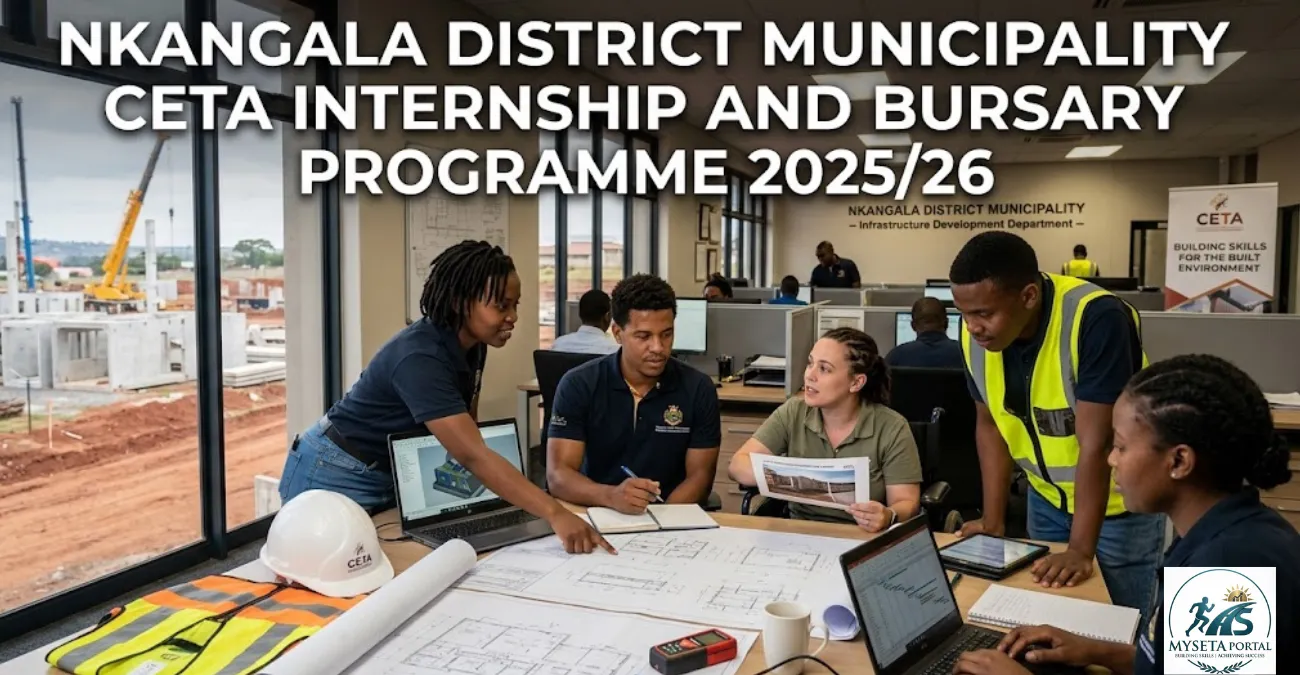
Breaking into South Africa’s job market can feel frustrating when employers ask for experience before offering your first opportunity. For graduates and students in the construction and built environment sector, the Nkangala District Municipality Graduate Internship and Skills Development Bursary Programme 2025/26 may offer a practical pathway into long-term employment.
Launched in partnership with the Construction Education and Training Authority, this opportunity combines workplace exposure, practical industry experience, and financial support for studies linked to infrastructure and construction careers.
Based in Middelburg, the programme targets both unemployed graduates needing workplace experience and employed individuals who want funding to continue studying construction-related qualifications.
What Is the Nkangala Graduate Internship and Bursary Programme?
The programme consists of two separate opportunities:
Graduate Internship Programme
This stream is designed for unemployed graduates who need real workplace exposure.
Successful applicants will receive:
- 12 months of workplace experience
- R60,000 annual stipend
- Exposure to construction and built environment projects
- Practical municipal and infrastructure-sector experience
The programme plans to support 20 internship beneficiaries.
For many graduates, the biggest obstacle after university or college is the “experience barrier” — employers expecting practical skills before offering entry-level jobs. Municipal internships funded through SETA partnerships often help bridge this gap by exposing graduates to real projects, reporting systems, compliance procedures, technical documentation, and workplace expectations.
At approximately R5,000 per month before deductions, the stipend also provides temporary financial support while graduates build employable skills.
Skills Development Bursary Programme
The bursary stream focuses on employed South Africans who want to continue studying.
The municipality plans to fund:
- 50 bursary beneficiaries
- Up to R80,000 per beneficiary
This financial support can help reduce the burden of:
- Tuition fees
- Registration costs
- Academic materials and textbooks
- Related study expenses
Priority Fields of Study
Construction and Built Environment Qualifications
Priority will be given to applicants studying or qualified in fields such as:
- Civil Engineering
- Construction Management
- Electrical Engineering
- Quantity Surveying
- Other construction-related qualifications
These qualifications remain strategically important in South Africa because infrastructure delivery, municipal services, roads, housing, energy systems, and public works projects continue to shape economic growth and employment opportunities.
Graduates entering these fields are building skills that can transfer into careers in local government, consulting firms, infrastructure contractors, engineering companies, utilities, and project management environments.
Why This Opportunity Matters for Future Employability
Many young South Africans underestimate how valuable a municipal internship can become in the long term.
A programme like this does more than provide temporary income — it builds practical workplace credibility.
During a municipal internship, participants may gain exposure to:
Technical Workplace Skills
- Infrastructure planning processes
- Construction project coordination
- Site documentation and reporting
- Engineering administration
- Procurement and compliance systems
- Municipal project workflows
Employability Skills Employers Value
Graduates also strengthen transferable skills such as:
- Professional communication
- Problem-solving
- Project coordination
- Technical reporting
- Time management
- Stakeholder engagement
These are the same capabilities employers often look for when hiring for junior technical, engineering, or project support roles.
In South Africa’s labour market, combining an NQF qualification with practical experience often improves employability significantly compared to holding qualifications alone.
Graduate Internship Programme Requirements
Applicants must:
- Be South African citizens
- Be between 18 and 35 years old
- Applicants above 35 may still be considered
- Hold an NQF Level 6 to 8 qualification
- Be currently unemployed
- Not participate in another internship or learnership
Priority will be given to:
- Women
- Youth from previously disadvantaged backgrounds
- Persons with disabilities
- Graduates with limited or no work experience
This aligns with broader national goals around skills development, transformation, inclusion, and youth employment support.
Skills Development Bursary Requirements
Applicants for the bursary programme must:
- Be employed South African citizens
- Hold a National Senior Certificate (Grade 12)
- Be accepted or registered at:
- A public university
- An accredited TVET college
- Show commitment to career growth and skills development
Priority consideration will be given to:
- Youth
- Women
- Persons with disabilities
- First-generation university or TVET students
- Employees furthering studies in approved fields
Documents Required for Internship Applications
Applicants should prepare:
- Completed CETA application form
- Updated Curriculum Vitae (CV)
- Certified copy of South African ID (not older than six months)
- Certified copies of:
- Matric certificate
- Academic qualifications
- Latest academic transcript
The municipality indicates that the application form is available through the official municipal website.
Documents Required for Bursary Applications
Applicants must submit:
- Curriculum Vitae (CV)
- Certified ID copy (not older than six months)
- Certified copies of:
- Matric certificate
- Academic qualifications
- Latest academic transcript
- Proof of registration at an accredited institution
- Motivation letter (maximum one page)
Your motivation letter matters more than many applicants realise.
This is your chance to explain:
- Your career ambitions
- Why you selected your field of study
- How funding will help your future goals
- How your qualification contributes to infrastructure and development
How to Apply
Applications may be submitted through email or hand delivery.
Email Submission
Applications can be sent to:
Hand Delivery Address
Nkangala District Municipality
Enquiries
Applicants may contact:
Mr. Mgobozi
Telephone: 013 249 2128
Email: Mgobozimsg@nkangaladm.gov.za
Mr. Edwin Mametja
Telephone: 013 249 2160
Email: mametjae@nkangaladm.gov.za
Closing Date: 29 May 2026
Applications close on 29 May 2026.
Late or incomplete applications are unlikely to be considered, so preparing documents early can help avoid last-minute issues.
Martine Smith’s Expert Insight
Many strong applicants miss opportunities because of avoidable mistakes. Here are practical ways to improve your chances:
1. Stop Sending Generic CVs
Construction and municipal internships are skills-based.
Tailor your CV to highlight engineering modules, technical projects, practical assignments, software knowledge, laboratory work, or infrastructure-related coursework.
Even student projects count when experience is limited.
2. Your Motivation Letter Should Sound Specific
A weak application says:
“I need funding to finish school.”
A stronger approach explains:
“I want to build expertise in municipal infrastructure delivery, electrical systems, or construction management.”
Be clear about your direction.
3. Check Every Certified Document Carefully
One of the most common mistakes is submitting:
- Expired certifications
- Missing transcripts
- Unclear scanned copies
- Incomplete PDFs
Before submitting, create one organised PDF file and review everything twice.
4. Apply Before the Deadline Rush
Avoid applying on the final day.
Email failures, attachment issues, and missing documents become more common near deadlines.
Submitting early shows professionalism and gives time to correct mistakes if needed.
What you can access:
- Career Guides
- SETA Guides
- SETAs
- Bursaries
- Learnerships
- Internships
- TVET Opportunities
- Apprenticeships
- Graduate Programme
- Government Services
- SASSA News & Updates
Final Thoughts
If you are struggling to move from qualification to employment, opportunities like the Nkangala District Municipality CETA Internship and Skills Development Bursary Programme can provide practical experience, funding support, and stronger employability in South Africa’s infrastructure economy.
Before applying, update your CV, organise your certified documents, and double-check every requirement. You can also track similar internships, bursaries, SETA opportunities, and application guidance through Mysetaportal.co.za.
Disclaimer: Mysetaportal.co.za is an independent information publisher that shares career, learnership, bursary, internship, and SETA-related opportunities. It is not an official government website, municipality, SETA, or state entity. Applicants should always verify programme details through official institutions before applying.

Martine Smith is the Founder and Managing Editor of MY SETA portal, he writes about SETA learnerships, internships, bursaries and youth employment opportunities in South Africa. His goal is to help young people access trusted career information and skills development programmes. Email: info@mysetaportal.co.za